
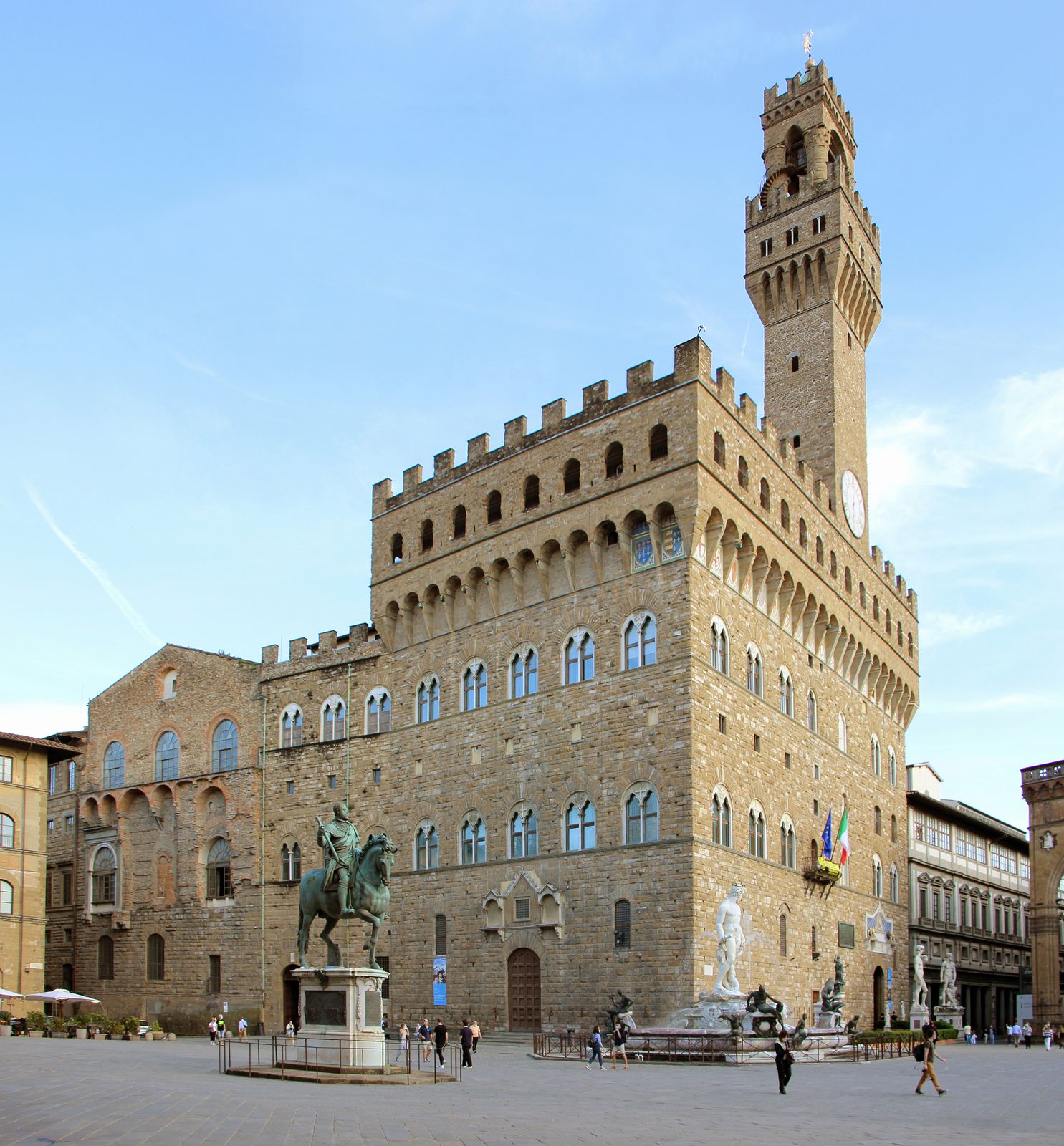
Palazzo Vecchio
- palace
- Price: €13 - €18
- Opening hours: 09:00 - 19:00 (Thu until 14:00)
History
Arnolfo di Cambio designed this crenellated, deliberately asymmetrical fortress from 1299 as the seat of the Priori, the guild-based council that governed Florence, and in one guise or another it has never stopped being the city's town hall since — a continuity almost unmatched among Europe's medieval civic buildings. For over two centuries it was simply Florence's Palazzo della Signoria, the beating heart of an independent republic.
That changed in 1540, when Cosimo I de' Medici moved his ducal court into the building, formally announcing that Florence now answered to one family rather than its old republican councils. Cosimo commissioned Giorgio Vasari to redecorate the interior on a scale suited to a prince, and though the duke relocated across the river to the grander Palazzo Pitti a couple of decades later, the ground floor of his old seat never stopped functioning as Florence's actual city hall — it still does today.
Did you know?
Before Vasari ever picked up a brush there, the Salone dei Cinquecento was meant to carry an almost unimaginable pairing of frescoes: the Florentine republic had commissioned Leonardo da Vinci to paint the Battle of Anghiari on one wall and Michelangelo to paint the Battle of Cascina on the facing wall — the two greatest living artists of the age, working feet apart in the same hall.
Neither fresco was ever finished. Michelangelo was called to Rome before he got past preparatory drawings, and Leonardo's experimental painting technique famously failed as he worked, causing the paint to run before he abandoned the project. When Vasari later redecorated the hall for Cosimo I, he painted over whatever traces remained with his own battle scenes — and generations of scholars and restorers have since searched, so far without confirmed success, for any surviving fragment of Leonardo's work hidden beneath.
The Salone dei Cinquecento
Even without its lost frescoes, the Salone dei Cinquecento is a room built to overwhelm. It was constructed from 1494 for the Great Council of Florence's short-lived republican government under Girolamo Savonarola, and at 54 metres long, 23 metres wide and 18 metres high, it remains one of the largest and most spectacular civic interiors in Italy — an audience chamber turned parliament hall turned ducal showcase.
Vasari's ceiling and wall paintings, celebrating Cosimo I's military victories over Pisa and Siena, cover practically every surface in gilded, crowded detail, while Michelangelo's sculpture the Genius of Victory stands at one end, originally carved for the pope's tomb and later given a home here instead. The hall alone justifies a ticket, quite apart from the tower or the rest of the palace.
Good to know
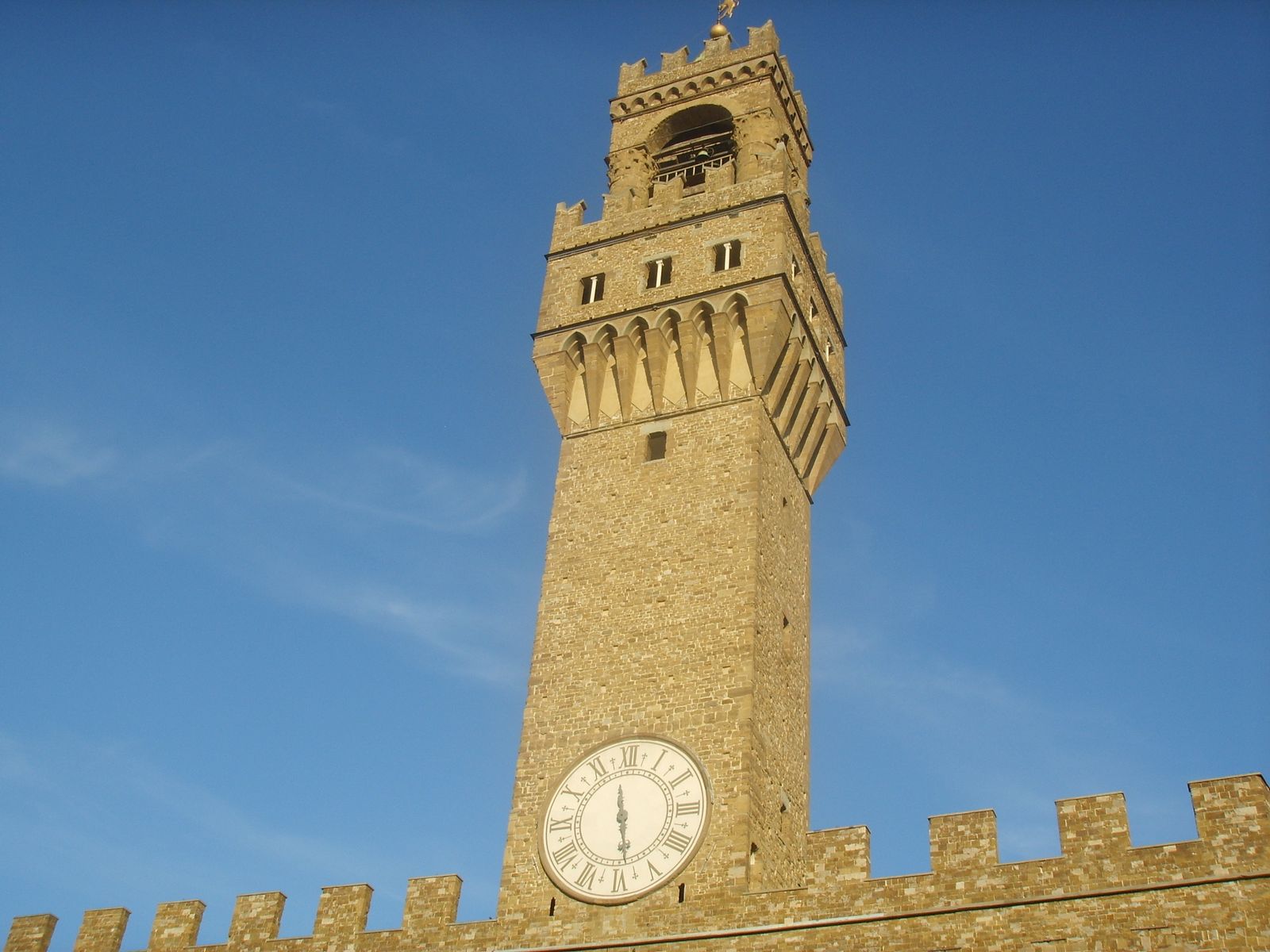
The 94-metre Torre di Arnolfo is one of the best viewpoints over central Florence, but the climb is genuinely demanding — narrow, uneven medieval stairs with no lift, and access is sometimes suspended in bad weather or high wind, so check on arrival rather than assuming it's included in your visit.
Because it's a functioning seat of city government as well as a museum, a handful of rooms are occasionally closed to visitors for official business — a minor inconvenience easily forgiven given the setting, right on Piazza della Signoria beside the Uffizi and the Loggia dei Lanzi, making it effortless to combine into a single walk through the historic centre.