
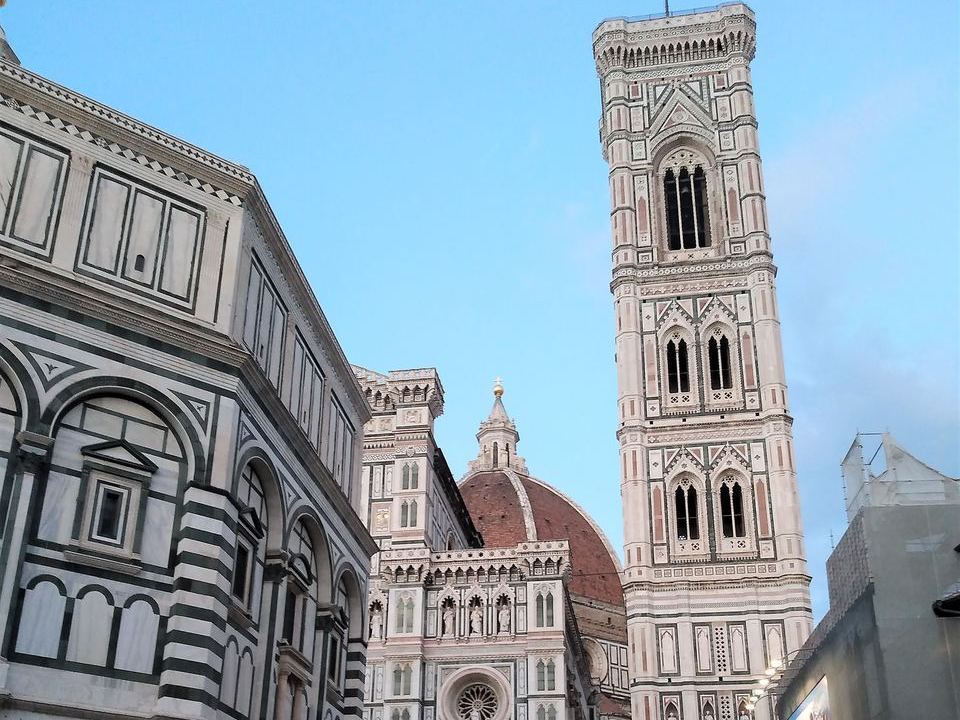
Giotto's Bell Tower
- viewpoint
- sacred
- Price: €20 - €30
- Opening hours: 08:15 - 18:45 Mon-Fri; 08:15 - 16:30 Sat; 12:45 - 16:30 Sun & holidays
History
Giotto di Bondone was already the most celebrated painter in Italy when the city named him head of the cathedral works in 1334, at around 67 years old and with no formal training as an architect. He laid the first stone on 19 July that year and got no further than the base level before his death in 1337, leaving the design and its completion to others. Andrea Pisano, fresh from casting the Baptistery's celebrated south doors, took over in 1343 and added the second tier with its hexagonal and lozenge-shaped relief panels, only for the Black Death to sweep through Florence in 1348 and halt construction along with much of the city's life.
Work resumed under Francesco Talenti, who between 1348 and 1359 designed and built the tower's final three storeys, departing from Giotto's original plan by opening large Gothic windows to lighten the upper mass and bring the tower to its full height of 84.7 metres. Clad in the same white, green and pink marble as the cathedral and the Baptistery, the finished tower reads as a single, continuous piece of Florentine craftsmanship even though it took three architects and a quarter of a century, interrupted by plague, to complete.
Did you know?
The bell tower once carried an extraordinary set of sculptures illustrating human progress and the planets, made by Andrea Pisano and, later, generally attributed in part to Donatello. Decades of pollution and weathering eventually made their removal unavoidable, and in the 1960s the originals were taken down and replaced with the copies visible today; the real panels and statues now live nearby in the Museo dell'Opera del Duomo, where they can be studied at eye level.
Despite the name, few visitors come away remembering the bells. What they remember instead is the view: because the tower stands apart from the cathedral rather than attached to it, it offers an unobstructed, close-up look at Brunelleschi's dome that you simply cannot get from the dome itself. Climbers often say the bell tower gives the best view of the dome, while the dome gives the best view of the city.
Good to know
There is no lift, so reaching the top means climbing all 414 steps in one continuous effort, with a handful of landings along the way to catch your breath. The staircases run in straighter flights than the dome's tightly wound spiral, which makes the climb feel more open, but it is still a real physical effort and the tower is not accessible to wheelchair users or anyone with mobility difficulties.
Compared with the queues for Brunelleschi's dome, the bell tower is often noticeably calmer, and arriving right at opening time on a weekday tends to mean climbing with hardly anyone else on the stairs. Many visitors treat it as an easier, less crowded alternative to the dome climb, or combine both in the same visit using a cumulative ticket that also covers the cathedral, baptistery and crypt.