
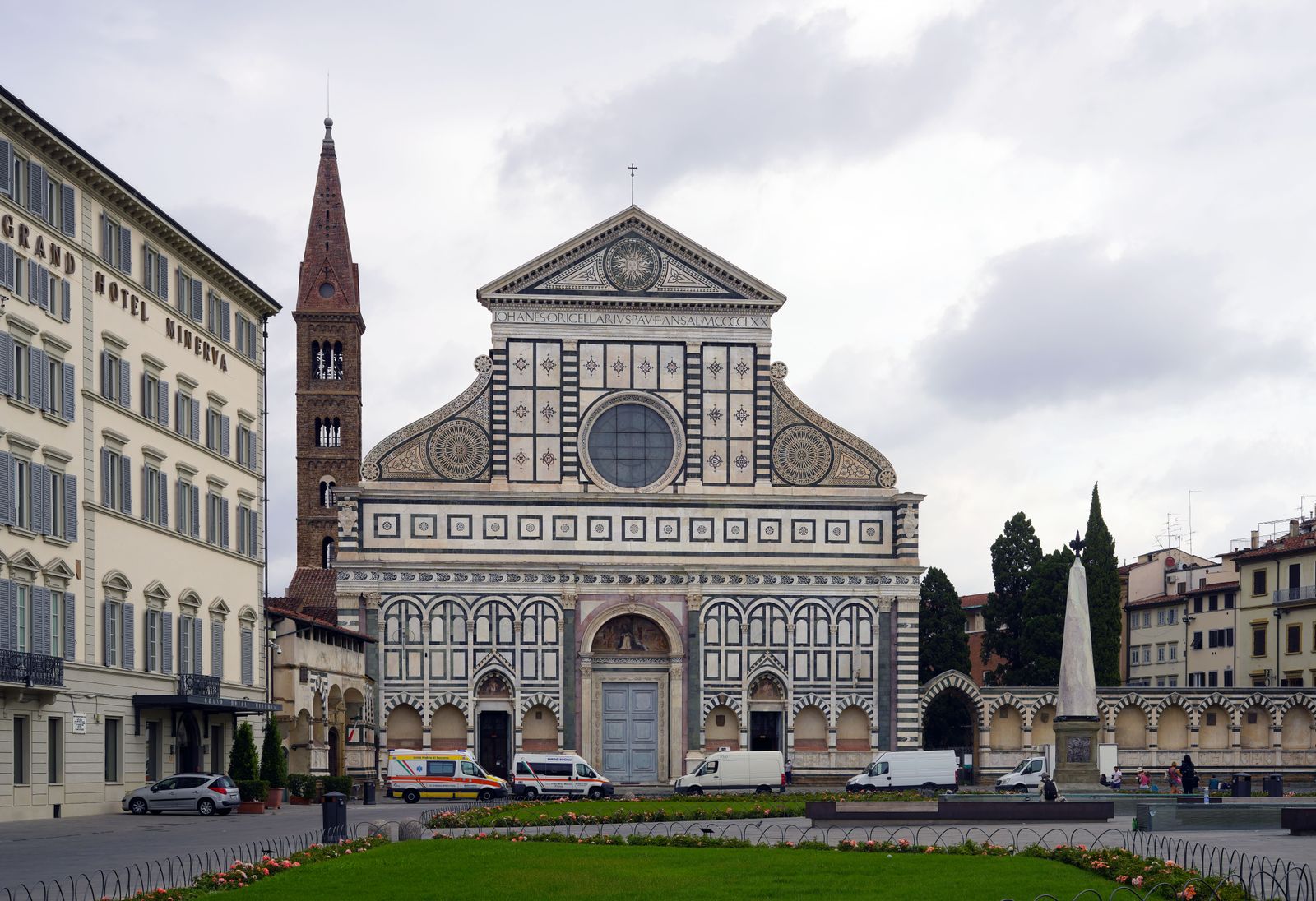
Basilica of Santa Maria Novella
- sacred
- Price: €8 - €9
- Opening hours: 09:00 - 17:30 (Sun 13:00 - 17:00, hours vary by day)
History
Dominican friars began building Santa Maria Novella in 1279 on the site of an older oratory, raising a Gothic nave and a run of side chapels over the following century — chapels that would later be frescoed by some of the leading painters of the age, including Masaccio, Domenico Ghirlandaio and Filippino Lippi. The lower half of the facade, with its green-and-white geometric marble panelling, belongs to that original Gothic campaign and was largely finished by the mid-14th century.
The upper half sat unfinished for over a hundred years, until the wealthy Rucellai banking family commissioned architect Leon Battista Alberti to complete it in 1470. Alberti's solution to a tricky problem — how to visually connect a wide central nave with the much narrower side aisles below it — was to bridge the gap with two enormous scroll-shaped volutes, a device so elegant it was copied on church facades across Europe for the next three centuries.
Did you know?
Inside, on the wall of the nave, hangs Masaccio's fresco of the Holy Trinity, painted around 1427. It's usually singled out as the first painting in history to apply the mathematics of linear perspective with total consistency, creating a painted architectural niche so convincing that Giorgio Vasari later wrote it looked as if a hole had been punched through the wall. Art historians often point to this single fresco as the moment Renaissance painting truly begins.
Alberti didn't just design the facade — he signed it, in giant Roman capitals, with the name of his patron: "IOHANES ORICELLARIVS", the Latinised form of Giovanni Rucellai. It's one of the earliest examples of a Renaissance patron putting his own name so prominently on a public building, a small act of self-promotion that other wealthy families were soon eager to copy.
Good to know
The ticket covers the basilica and its cloisters, including the Chiostro Verde ("Green Cloister"), named for the greenish terre-verte pigment used in Paolo Uccello's fresco cycle there, and the Spanish Chapel with its vast fresco of the Triumph of the Church. Opening hours vary by day of the week and shift on Sundays and religious holidays for services, so it's worth checking the current schedule before setting out.
The church stands right beside Firenze Santa Maria Novella, the city's main train station, which actually takes its name from the basilica rather than the other way around — meaning for many visitors this striking Renaissance facade is the very first or last thing they see in Florence. Its central location makes it an easy stop to combine with a day spent around the station or heading to and from the airport train.