
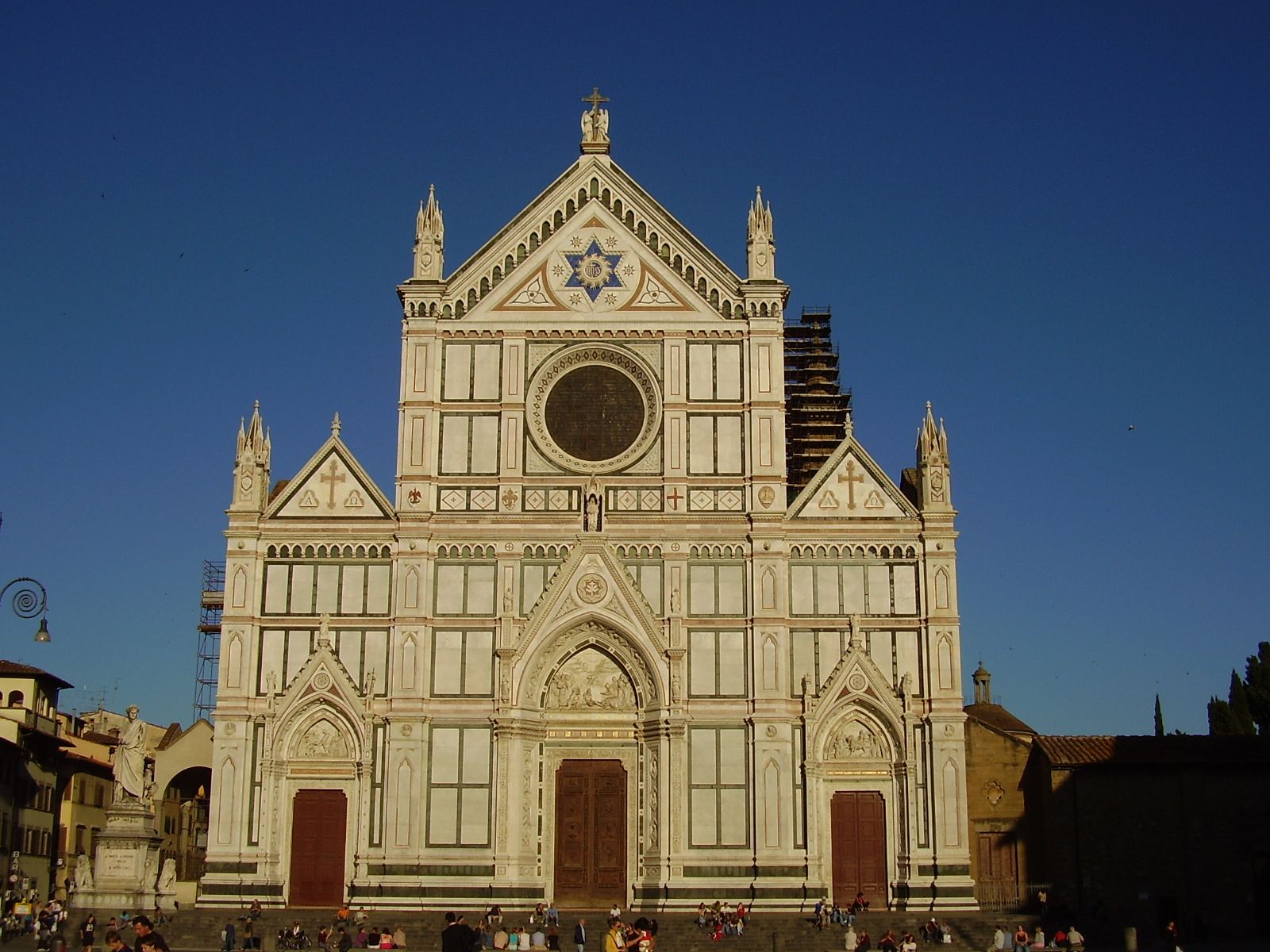
Basilica of Santa Croce
- sacred
- Price: €8 - €10
- Opening hours: 09:30 - 17:30 (Sun 13:00 - 17:30)
History
Franciscan friars began this vast church in 1294, on a design reputedly by Arnolfo di Cambio, the architect who also began Florence's cathedral. Construction was financed largely by the city's wealthiest wool-merchant and banking families — the Bardi, Peruzzi and Alberti among them — who in return got their own private chapels along the transept, several frescoed by Giotto and his workshop with scenes from the lives of Saint Francis and John the Baptist.
The building took more than a century to complete, and even then it stood without a proper facade — just bare stone — for another five hundred years. It wasn't until 1863 that the neo-Gothic marble front visible today was finally added, designed by Niccolò Matas and paid for by an English patron, so what greets visitors in the piazza is in fact a Victorian addition to a medieval church.
Temple of the Italian Glories
Since the 16th century Santa Croce has served as Italy's pantheon of art and science, and its floor and walls are crowded with the tombs and monuments of the nation's greatest names. Michelangelo, who died in Rome in 1564, was smuggled back to his native Florence and buried here beneath a tomb designed by Giorgio Vasari; nearby lies Galileo Galilei, though his monumental tomb had to wait nearly a century after his 1642 death — condemned by the Inquisition, he was first interred quietly in a side room, and only moved to his place of honour in 1737 once the controversy had faded.
Elsewhere in the church lie the political theorist Niccolò Machiavelli and composer Gioachino Rossini, while a grand cenotaph honours Dante Alighieri — empty, since the poet is actually buried in Ravenna, the city that sheltered him in exile and has refused ever since to give his remains back to Florence. This concentration of illustrious graves inspired poet Ugo Foscolo's 1807 poem "Dei Sepolcri" ("Of Tombs"), which cemented the church's reputation and its enduring nickname, the "Temple of the Italian Glories."
Did you know?
Long stretches of the nave and chapels were once covered in frescoes that had faded or been whitewashed over the centuries; the catastrophic Arno flood of 1966, which submerged the basilica in mud and water up to four metres deep, ended up triggering decades of restoration that uncovered and saved many of them. The flood also famously damaged Cimabue's great Crucifix, kept in the refectory, which remains partly restored today as a deliberate reminder of the disaster.
The adjoining Pazzi Chapel, tucked into the first cloister, is one of Filippo Brunelleschi's last and most harmonious designs, built for the same Pazzi family later notorious for the 1478 conspiracy against the Medici. Its perfectly proportioned geometry — a circle inscribed in a square, capped by a dome of glazed terracotta roundels by Luca della Robbia — is often held up as a textbook example of early Renaissance architecture.
Good to know
A single ticket covers the basilica, the Pazzi Chapel and the cloisters, making it good value for a complex that easily takes an hour or more to see properly. Santa Croce is still a consecrated church with regular services, so visitors should dress modestly — covered shoulders and knees — and keep voices low, especially during Mass, when tourist visits are paused.
The basilica sits on its own broad piazza in the Santa Croce district, a short walk from the Duomo, and is usually far less crowded at opening time than later in the day. Photography without flash is generally allowed inside, but the Pazzi Chapel and cloister are worth saving unhurried time for — they're often overlooked by visitors who rush straight to the tombs.