
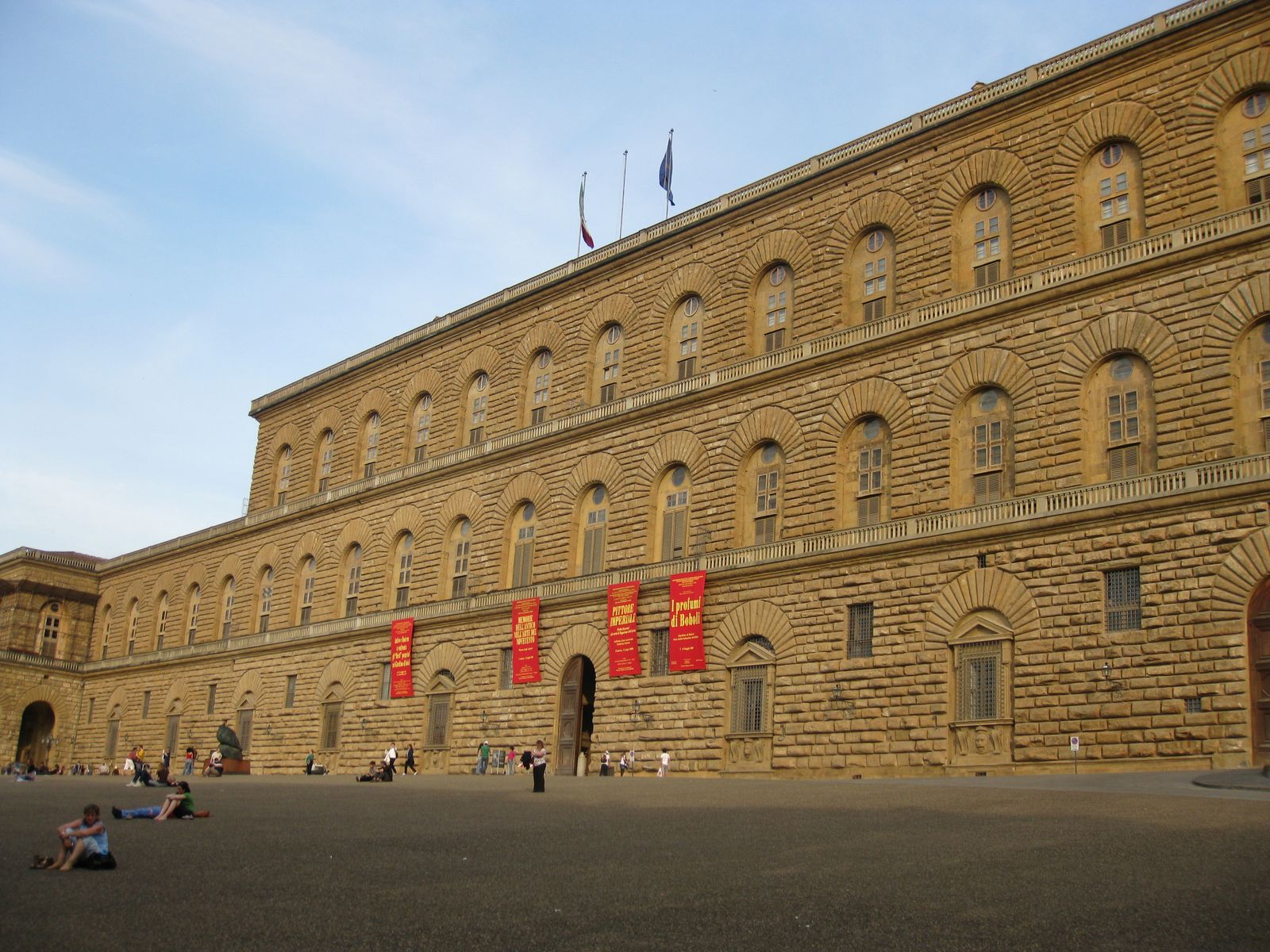
Palazzo Pitti
- palace
- art-museum
- Price: €2 - €16
- Opening hours: 08:15 - 18:30 (closed Mon)
History
Construction began around 1458 for Luca Pitti, a wool merchant and banker rich and ambitious enough to want a palace that outshone the Medici's own — according to a story that has followed the building ever since, he specifically ordered windows larger than the front door of the Palazzo Medici. The Pitti family's fortunes collapsed within a generation, however, and in 1550 Cosimo I de' Medici's wife, Eleonora di Toledo, bought the unfinished palace from Luca's heirs.
Once the Medici were in residence, the palace only grew: Cosimo I and his successors added two long wings, filled the hillside behind it with what became the Boboli Gardens, and in 1565 connected it to the Uffizi and the seat of government across the river via the elevated Vasari Corridor. Later occupied by the Habsburg-Lorraine grand dukes and, briefly, by Napoleon's sister Elisa, the palace was ceded to the Italian state in 1919 and opened to the public soon after.
Did you know?
That story about Luca Pitti's oversized windows is impossible to verify, but it captures something real about the palace: everything about it — its raw, rusticated stone facade, its sheer bulk — was built to intimidate and outclass the family it was meant to rival, before that same family ended up owning it.
The Boboli Gardens rising behind the palace were laid out from the 1550s around a quarry that had supplied the palace's stone, and Cosimo II later had that same quarry hollowed into a leafy amphitheatre. The gardens' formal terraces, long avenues and elaborate grottoes became a template copied across Europe, most famously by the gardens of Versailles.
Good to know
"Palazzo Pitti" is really an umbrella for several separate museums under one roof — the paintings-crammed Palatine Gallery, the Royal Apartments, the Treasury of the Grand Dukes, a costume and fashion gallery, and more — and a single combined ticket typically covers the palace's museums together with the Boboli and Bardini Gardens behind it. Confirm the current ticket structure before you go, since combinations and prices are adjusted periodically.
The palace is closed on Mondays, and the Boboli Gardens alone are worth a couple of unhurried hours — wear comfortable shoes, since the grounds climb steeply up the hillside behind the building.