
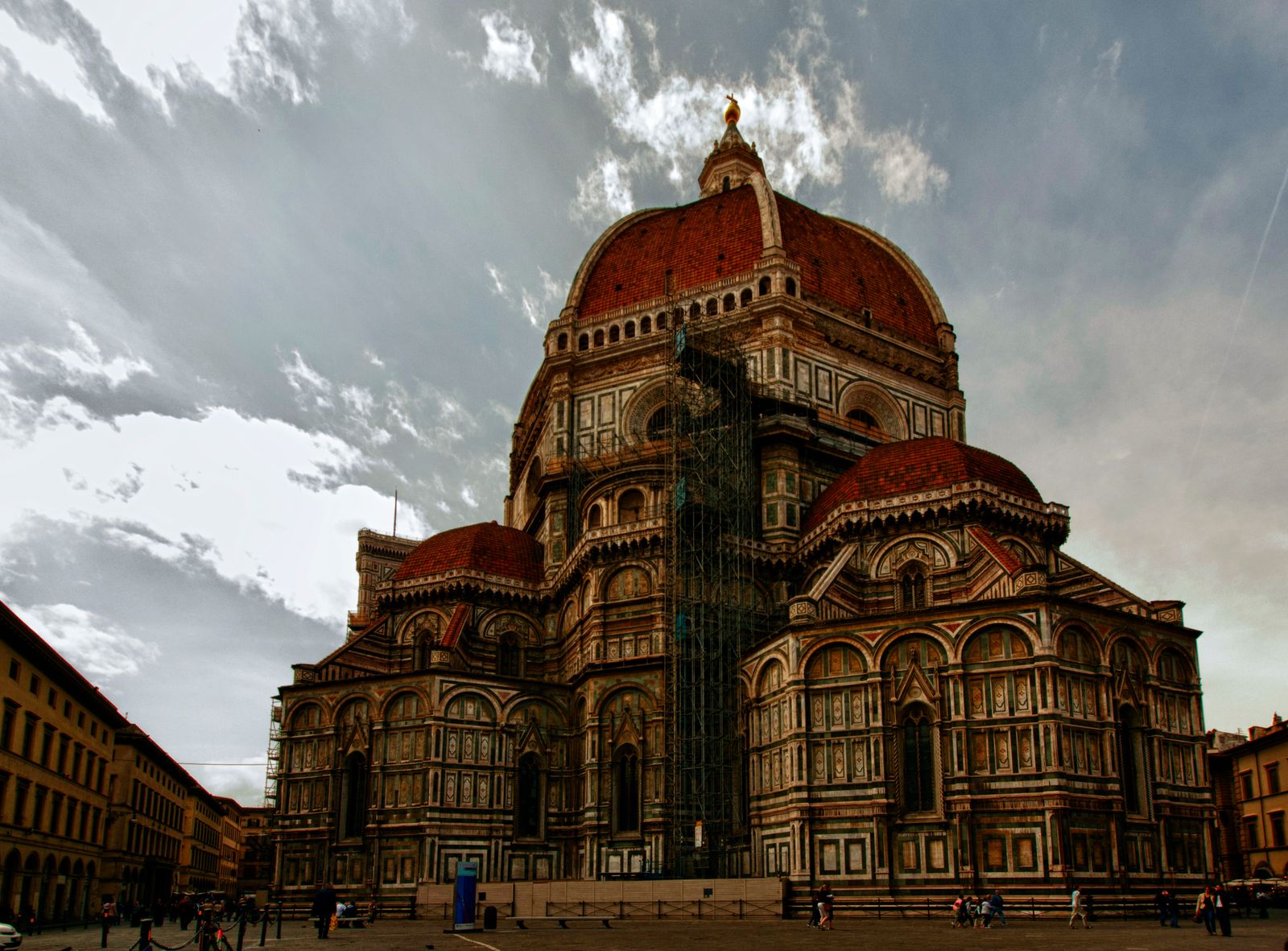
Florence Cathedral
- sacred
- Price: €15 - €30
- Opening hours: Cathedral 10:15 - 15:45 Mon-Sat; Dome 08:15 - 18:45 Mon-Fri (shorter Sat-Sun)
History
Florence broke ground on its new cathedral on 9 September 1296 under Arnolfo di Cambio, replacing the small and by then inadequate church of Santa Reparata to give the city a monument befitting its growing wealth and ambition. Arnolfo died around 1302 with only the lower sections built, and construction crept forward under a succession of architects over the following century, including Giotto, who turned his attention to the freestanding bell tower alongside the cathedral rather than the church itself.
The building was faced, like the Baptistery and bell tower beside it, in geometric panels of white, green and pink marble, a scheme that ties the whole cathedral complex together visually even though its various parts were designed and built generations apart. By the early 15th century the nave, aisles and crossing were essentially complete, but one problem remained unsolved: how to roof the vast octagonal crossing with a dome wider than anything attempted since antiquity.
Brunelleschi's Dome
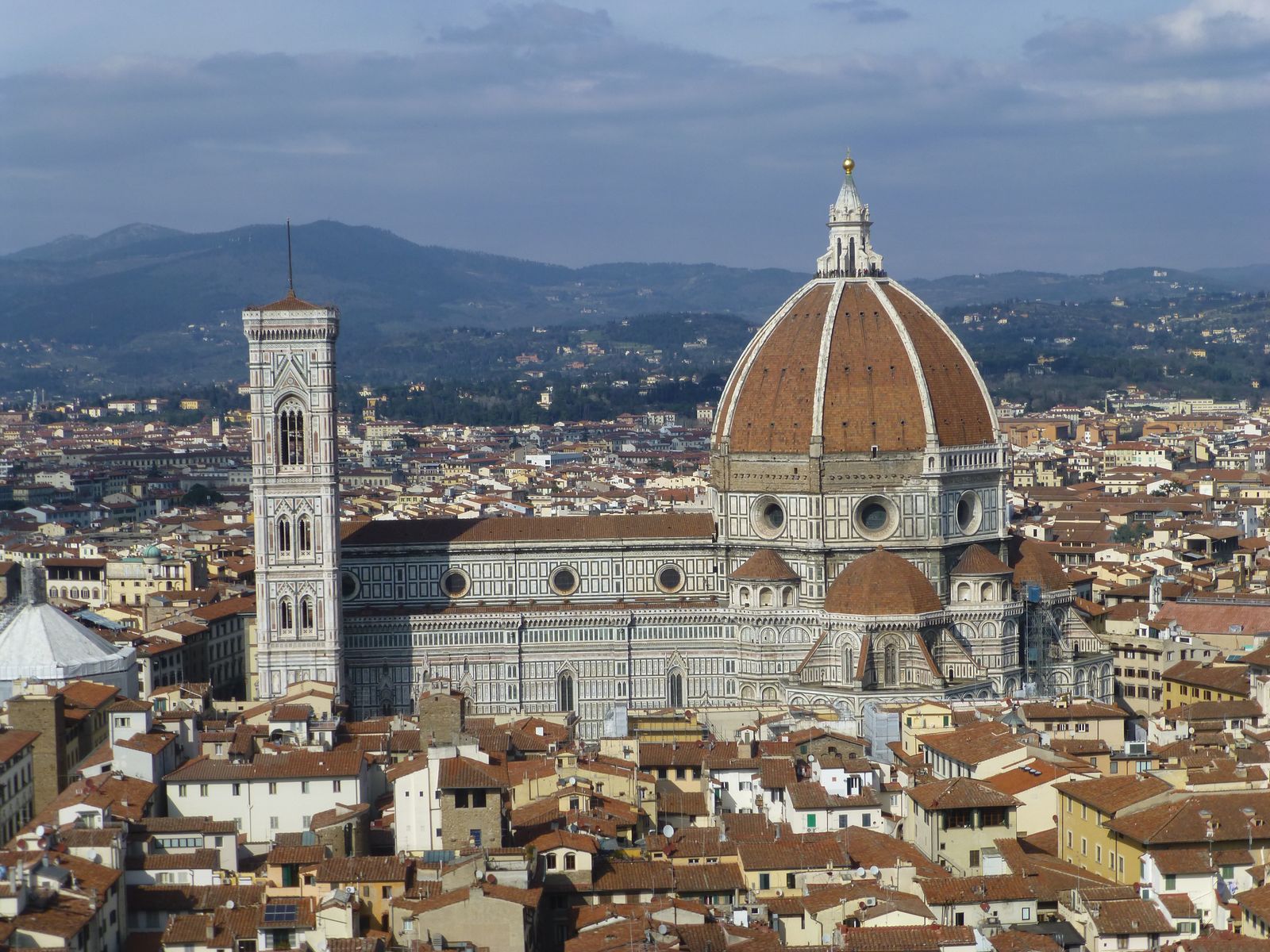
The span required, roughly 44 metres across, defeated architects for over a century; conventional wooden centering to support the masonry while it set simply could not be built at that scale, and no one had solved the engineering since the Romans raised the Pantheon over a thousand years earlier. In 1418 the cathedral authorities opened a competition for a solution, and the goldsmith-turned-architect Filippo Brunelleschi won it with a radical proposal: a self-supporting double-shell dome, built upward in horizontal rings using a herringbone brick pattern that let each course lock into place without needing centering underneath.
Construction of the dome ran from 1420 to 1436, and the cathedral was consecrated that same year by Pope Eugene IV in a ceremony attended by much of the city. Brunelleschi's solution remains one of the largest masonry domes ever built and still shapes the Florence skyline exactly as it did nearly six centuries ago, visible from almost anywhere in the historic centre.
Did you know?
Many visitors assume the cathedral's elaborate, brightly patterned marble facade is original to the building, but it dates only to 1887. The medieval facade was left unfinished and was eventually dismantled in the 16th century, leaving the cathedral's front in bare, undecorated stone for roughly three hundred years until the architect Emilio De Fabris won a competition to design the neo-Gothic facade that stands today — meaning the "medieval" front is, in reality, a 19th-century interpretation of what one might have looked like.
Inside the dome, look up: the interior is covered by one of the largest fresco cycles in the world, a sweeping Last Judgment begun by Giorgio Vasari in 1572 and completed after his death by Federico Zuccari, covering roughly 3,600 square metres of curved surface with a vast painted vision of heaven and hell.
Good to know
Visiting the cathedral itself and climbing the dome are two entirely different experiences with separate access and, at busy times, separate queues, so plan for both rather than assuming one ticket covers everything — a cumulative ticket also typically includes the bell tower, baptistery, crypt and Museo dell'Opera del Duomo.
The dome climb in particular requires a timed-entry booking, and in high season slots can sell out days or even weeks ahead, so reserve online well before your trip rather than hoping to walk up. The climb itself follows a narrow, one-way spiral staircase for much of its 463 steps with little room to pass other visitors, so it is not a good fit for anyone uncomfortable in tight, enclosed spaces.