
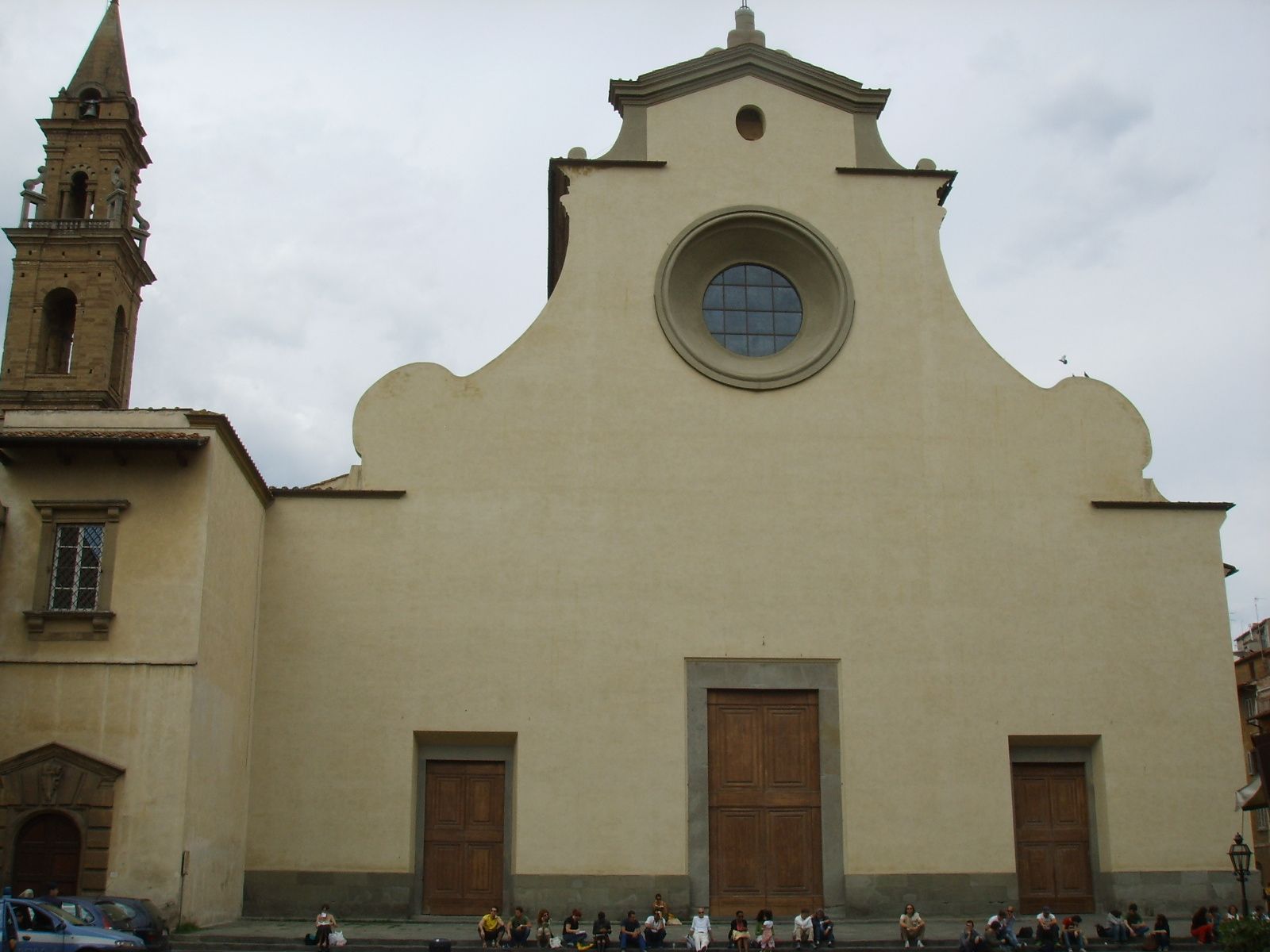
Basilica of Santo Spirito
- sacred
- Price: Free (sacristy €2)
- Opening hours: 10:00 - 13:00, 15:00 - 18:00 (Sun & holidays 11:30 - 13:30, 15:00 - 18:00); closed Wed
Book a guided tour of Firenze
Skip the line and see Firenze with a local guide.
History
Florence's Augustinian friars had been settled on this site since 1269, but their old church was demolished from 1434 to make way for a new design by Filippo Brunelleschi — one of the last projects he undertook before his death in 1446, and by his own account one of the ones he was proudest of. Construction dragged on for decades under three of his former assistants, who adapted parts of his plan along the way; the dome wasn't finished until 1482, and the basilica as a whole was essentially complete by 1487.
The plain, unadorned facade Brunelleschi had envisioned — a composition of pilasters and geometric proportion rather than applied marble decoration — was never built at all, and to this day the church presents little more than blank rendered plaster to the piazza outside. Inside, though, forty identical semicircular chapels ring the entire perimeter of the building in an unbroken rhythm of grey pietra serena stone, creating one of the purest and most influential interiors of the early Renaissance.
Did you know?
The blank exterior often surprises first-time visitors, since almost nothing about it hints at the harmony inside — Santo Spirito is sometimes cited as proof that Brunelleschi cared more about mathematical proportion and interior space than about outward display. A facade to his original design was proposed more than once in later centuries but never carried out, so what visitors see today is essentially an unfinished building, over five hundred years on.
In the sacristy off the left aisle hangs a small polychrome wooden crucifix carved around 1492–93 by Michelangelo, then just eighteen years old. According to a long-standing tradition, he made it as a gift for the prior of the convent, who had allowed him to study human anatomy on cadavers from the adjoining hospital — an early, private commission a world away from the grand marble works that would soon make him famous.
Good to know
Entry to the church is free, with a small charge of €2 only to see the sacristy and its Michelangelo crucifix, making Santo Spirito one of the best-value sights in central Florence. It's closed on Wednesdays, so it's worth checking the day before planning a visit, and — being a functioning parish church — Sunday mornings are given over to Mass rather than sightseeing.
Tucked into the Oltrarno, the quieter, more residential quarter south of the river, Santo Spirito draws a fraction of the crowds that queue for the Duomo or the Uffizi, even though its interior rivals them for architectural importance. The piazza outside hosts a small daily market and a lively evening scene, and it sits an easy walk from the Boboli Gardens and Palazzo Pitti, making it a natural stop on an Oltrarno afternoon.