
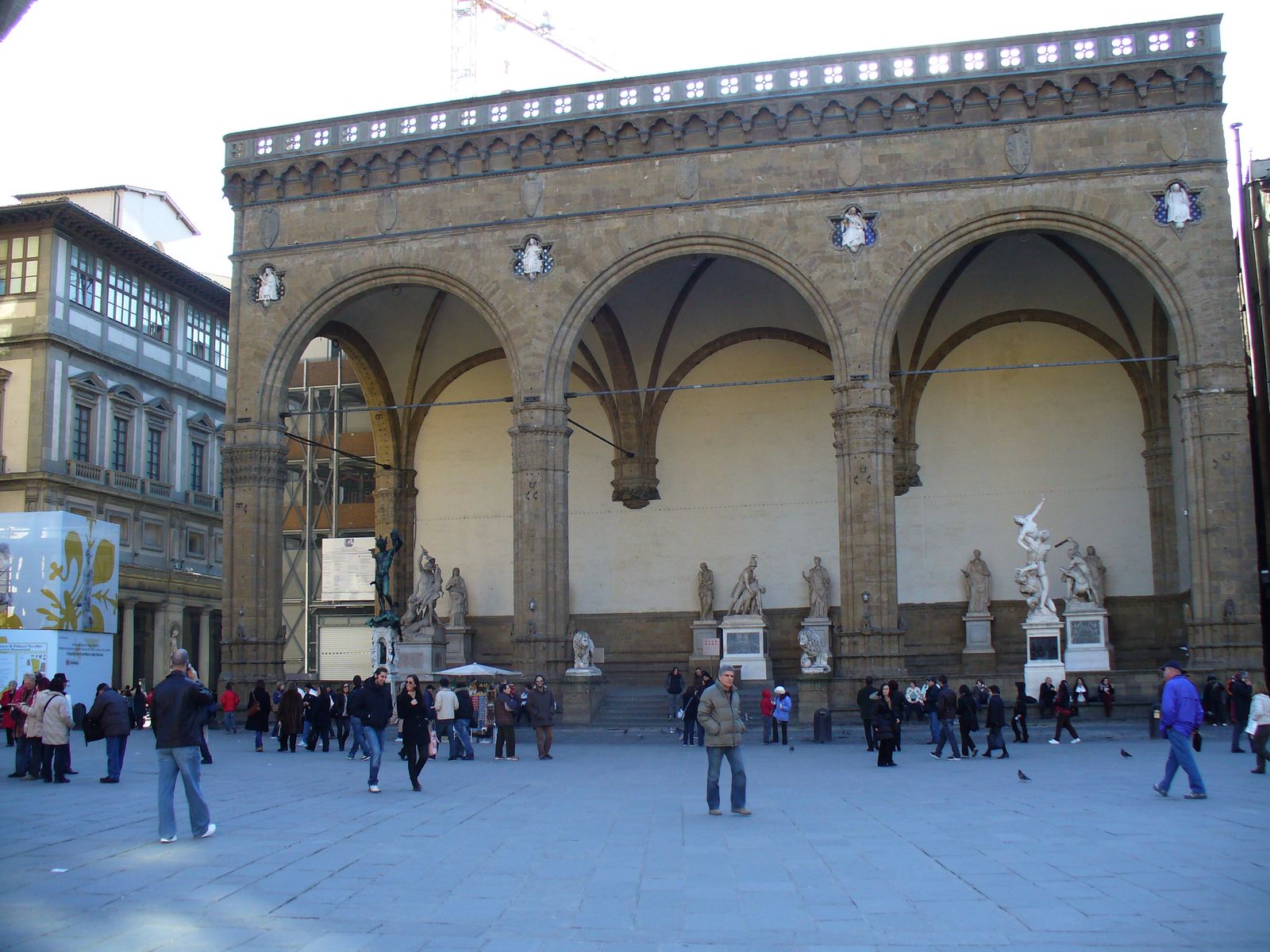
Loggia dei Lanzi
- monument
- Opening hours: Always open
Book a guided tour of Firenze
Skip the line and see Firenze with a local guide.
History
Built between 1376 and 1382 to a design attributed to Benci di Cione and Simone Talenti, the Loggia dei Lanzi was raised as a stage for the public life of the Florentine Republic: the swearing-in of the Signoria, official receptions, and ceremonies too important to hold indoors took place beneath its arches. Its three broad round arches were a conscious statement — Florence was turning away from the pointed Gothic forms still fashionable elsewhere and reaching instead toward the rounded, classically inspired vocabulary that would come to define the Renaissance.
The loggia's current name has nothing to do with its original purpose. In the 16th century, Cosimo I de' Medici stationed his German mercenary bodyguard, the lanzichenecchi (Landsknechts), here, and Florentines simply began calling the building after them. By then the Medici had already started installing sculpture beneath its arches, quietly converting a hall built for civic ceremony into one of the world's first open-air museums.
Did you know?
Cosimo I commissioned Benvenuto Cellini's bronze Perseus, unveiled in 1554 after nearly a decade of work, specifically to rival Donatello's and Michelangelo's sculptures already standing nearby in the piazza — a political statement in bronze as much as an artistic one. Cellini's own memoirs describe the casting almost going catastrophically wrong, with the artist reportedly feeding his own pewter tableware into the furnace to keep the molten bronze flowing.
Facing it, Giambologna's spiralling Rape of the Sabine Women, finished in 1583, was carved from a single, flawed block of marble that other sculptors had turned down. Giambologna set out only to prove he could weave three interlocking figures into one continuous upward spiral, viewable from every angle with no single "best" side — he had no subject in mind at all until the writer Vincenzo Borghini suggested the title after the work was already finished.
Good to know
Unlike almost every other major sight in the historic centre, the Loggia dei Lanzi has no ticket, no opening hours, and no queue — it's a public space, open to the air and free to walk through at any time, day or night.
It sits at the southern edge of Piazza della Signoria, right beside Palazzo Vecchio, so it's rarely a destination in its own right but rather a natural pause on the way between the square and the Uffizi. Visit early morning or after dinner for the emptiest photos, and don't be surprised if a statue is occasionally sheathed in scaffolding — these sculptures have stood exposed to Florence's weather for over four centuries and need regular conservation.